
Recently popular package Laravel-Excel released a new version 3.0, which was a pretty radical change from previous versions. I needed to do a simple Excel export and noticed that their documentation covers only export from Laravel Collections but not from some custom structure. So I will show you a "workaround".
First, this is how documentation describes the basic workflow:
namespace App\Exports;

use Maatwebsite\Excel\Concerns\FromCollection;

class InvoicesExport implements FromCollection
{
    public function collection()
    {
        return Invoice::all();
    }
}
You need to create a separate class for export (similar how Laravel Notifications work) and you can define a collection to export.
There are also other ways to export the data:
From Eloquent query:
class InvoicesExport implements FromQuery
{
    use Exportable;

    public function query()
    {
        return Invoice::query();
    }
}
Or, from View HTML table:
class InvoicesExport implements FromView
{
    public function view(): View
    {
        return view('exports.invoices', [
            'invoices' => Invoice::all()
        ]);
    }
}
But still, the problem is that all examples are based on Eloquent. What if I need Excel from some custom structure like array?
Imagine that I have this array:
[
  [
    'name' => 'Povilas',
    'surname' => 'Korop',
    'email' => '[email protected]',
    'twitter' => '@povilaskorop'
  ],
  [
    'name' => 'Taylor',
    'surname' => 'Otwell',
    'email' => '[email protected]',
    'twitter' => '@taylorotwell'
  ]
]
How do I export that into Excel, so that keys would be columns, and values would be rows?
There are two ways.
Option 1. Turn your Array into a Collection and add Headings
This is how the Export class would look:
namespace App\Exports;

use Maatwebsite\Excel\Concerns\FromCollection;
use Maatwebsite\Excel\Concerns\Exportable;
use Maatwebsite\Excel\Concerns\WithHeadings;

class CollectionExport implements FromCollection, WithHeadings
{
    use Exportable;

    public function collection()
    {
        return collect([
            [
                'name' => 'Povilas',
                'surname' => 'Korop',
                'email' => '[email protected]',
                'twitter' => '@povilaskorop'
            ],
            [
                'name' => 'Taylor',
                'surname' => 'Otwell',
                'email' => '[email protected]',
                'twitter' => '@taylorotwell'
            ]
        ]);
    }

    public function headings(): array
    {
        return [
            'Name',
            'Surname',
            'Email',
            'Twitter',
        ];
    }

}
You need to implement collection() method by using Laravel's collect() method and passing array to it. Also, you need to implement headings() to add a header row.
Finally, in Controller you will have this row at the end of the method:
return Excel::download(new CollectionExport(), 'export.xlsx');
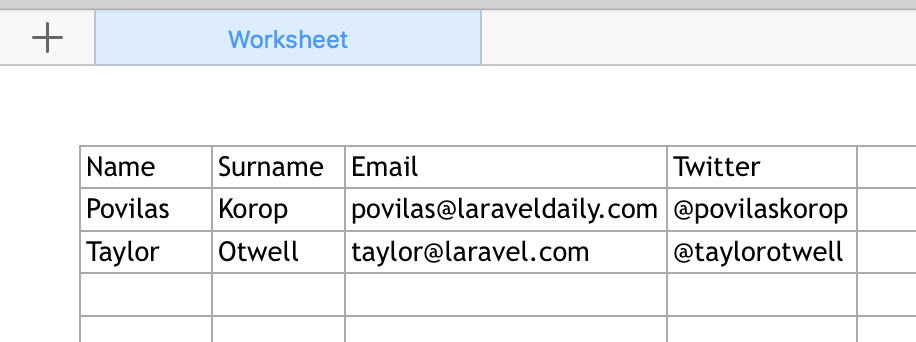
Then you would have this as downloaded result:
Option 2. Pass Array into View
Alternatively, you can build this resources/views/exports/xml.blade.php:
<table>
    <thead>
    <tr>
        @foreach($data[0] as $key => $value)
        <th>{{ ucfirst($key) }}</th>
        @endforeach
        </tr>
    </thead>
    <tbody>
    @foreach($data as $row)
        <tr>
        @foreach ($row as $value)
            <td>{{ $value }}</td>
        @endforeach
    </tr>
    @endforeach
    </tbody>
</table>
And then have this in your Export class:
namespace App\Exports;

use Illuminate\Contracts\View\View;
use Maatwebsite\Excel\Concerns\FromView;

class BladeExport implements FromView
{

    public function view(): View
    {
        return view('exports.xml', [
            'data' => [
              [
                'name' => 'Povilas',
                'surname' => 'Korop',
                'email' => '[email protected]',
                'twitter' => '@povilaskorop'
              ],
              [
                'name' => 'Taylor',
                'surname' => 'Otwell',
                'email' => '[email protected]',
                'twitter' => '@taylorotwell'
              ]
            ]
        ]);
    }
}
Controller stays the same, just different class name:
return Excel::download(new BladeExport(), 'export.xlsx');
Wait, but how to pass data into Export class?
Both of our examples have one flaw - the data is formed in the class itself. Actually, it shouldn't even know about the data, it should accept it as a parameter. But how do we do that, if view() or collection() methods have no parameters?
We will pass it through __construct() method into a private variable. You could call it a dependency injection, although there are much better examples of dependency injection, look it up on Google.
class BladeExport implements FromView
{

    private $data;

    public function __construct($data)
    {
        $this->data = $data;
    }

    public function view(): View
    {
        return view('exports.xml', [
            'data' => $this->data
        ]);
    }
}
So we're accepting $data as a parameter now. Then, in our Controller we can have this:
$data = [
    [
        'name' => 'Povilas',
        'surname' => 'Korop',
        'email' => '[email protected]',
        'twitter' => '@povilaskorop'
    ],
    [
        'name' => 'Taylor',
        'surname' => 'Otwell',
        'email' => '[email protected]',
        'twitter' => '@taylorotwell'
    ]
];

return Excel::download(new BladeExport($data), 'export.xlsx');
I hope that's helpful. Check out other examples in official documentation of the package.